

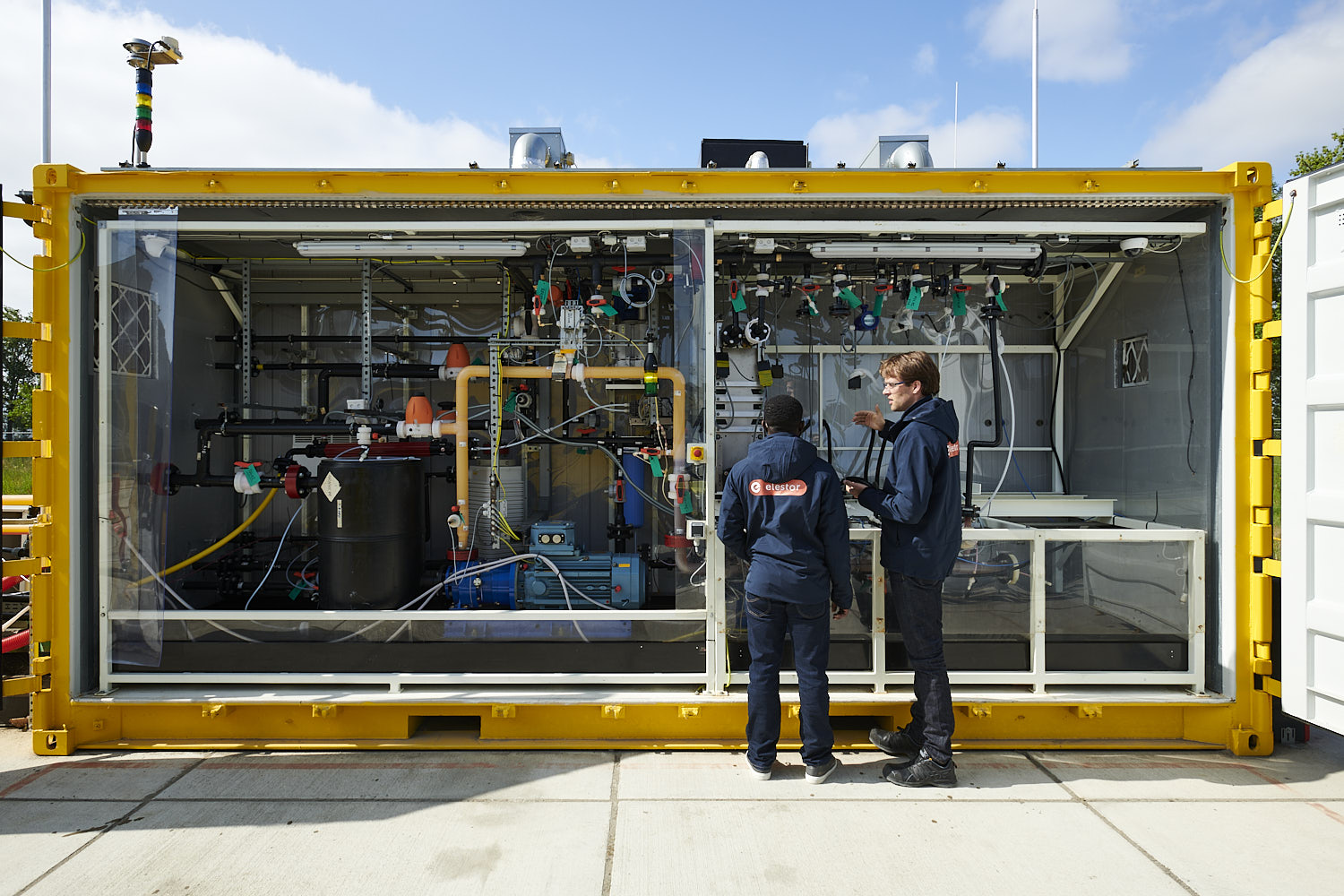
For the energy transition to succeed, sufficient renewable generation is required, but also the ability to store that energy for longer periods. Technologies capable of storing energy between eight and one hundred hours can play a crucial role. A broad consortium has received €22 million in funding from the Dutch National Growth Fund for the so-called SLDBatt project (Sustainable Long Duration Battery), which focuses on long-duration electricity storage.
One of the project participants, Elestor, explains how its battery technology can contribute to a sustainable future.
“With Elestor, we are launching a pilot in which we will deploy a 1 megawatt-hour system,” says Wiebrand Kout, founder of the Arnhem-based company and participant in the project. “We are building the largest hydrogen flow battery ever. It is fundamentally different from the lithium systems commonly seen today. Those typically offer storage durations of two to sometimes four hours. With our battery, we are targeting storage starting at ten hours. In total, the SLDBatt project consists of five pilots, with the overall objective of accelerating the launch of long-duration battery storage technologies.”
Battery Competence Cluster NL is coordinating the project. In addition to Elestor, the consortium includes the University of Twente, TU Delft, TU Eindhoven, the Arnhem and Nijmegen University of Applied Sciences, AQUABATTERY, Exergy Storage, Nobian, and RWE.
“Within the consortium, responsibilities are clearly defined,” adds Hylke van Bennekom, CEO of Elestor. “We have different work packages and collaborate closely with partners within the consortium. A common denominator is the Centre of Expertise, where the knowledge and results of the pilots are consolidated. Each pilot addresses a specific part of the challenge, and all that knowledge comes together there. This collaboration is powerful and effective: each partner in the consortium is a frontrunner in the development of long-duration energy storage, and after years of cooperation, we are building further on a strong foundation of trust.”
How the battery works
“The technology used in the pilot is based on a 100% stable and reversible reaction,” says Van Bennekom. “This means there are no issues related to deep discharge or cycle limitations. Once stabilized, you have a robust product in principle. Combined with ultra-low raw material costs, this gives us the potential to be disruptive in the energy storage landscape.”
The technology has the potential to reach costs of €15 per kilowatt-hour at scale. The levelized cost of storage, the cost per kilowatt-hour for storing energy in the battery, is projected at €0.02. “This provides a technology that is independent of location, geopolitics, and supply chain constraints, and can be deployed anywhere in the world.”
“We are always looking for a single solution that solves everything, but that does not exist,” Van Bennekom continues. “Our solution focuses on storage from eight hours onward, preferably 12 hours or more. Ultimately, this technology can replace gas-fired power plants, but even at smaller scale it already makes a difference. We will install this pilot next year. Shortly after, the commercial product will become available, batteries starting at 15 megawatt-hours and larger. The next step is delivering even larger versions.”
“At its core, the system is highly modular, essentially copy-paste. That is the beauty of this technology. Power and capacity are fully independently scalable and configurable. To turn a large battery into a mega-battery, you simply need space to store more liquid. Technologically, nothing changes.”
Elestor expects the battery to last between twenty and thirty years.
“That may sound ambitious, but flow batteries are capable of that,” says Kout. “This has already been demonstrated. A German company showed this before — systems commissioned ten years ago are still operating today. It’s a completely different animal compared to lithium batteries. Lithium batteries expand and contract and eventually degrade. A flow battery operates differently: the energy is not stored in the cells themselves but in external tanks. The cells resemble fuel cells. The difference is that the materials are subjected to far less stress.”
Shift toward commercial realization
“What I am most proud of so far is that we are achieving strong lifetime results,” Kout continues. “This project feels like recognition, and that is motivating. It is still too early to say we have achieved all the project’s goals. The plan is in place, and the technology shows we are on the right track. All signals are green.”
Of course, challenges remain, but they are evolving.
“The first challenge was simply getting the project up and running,” says Kout. “That phase is behind us, and we are stable. The current challenge is translating a strong platform technology into something customers can apply. The focus is shifting from research to engineering. You can see that reflected in the team we have built over the past few years. We have been looking for people who can make that translation. It is also a challenge to reach sufficient critical mass and get the snowball rolling.”
What is the battery’s greatest advantage? “A technology like this makes it possible to provide renewable generation to the grid in a stable way,” says Van Bennekom. “That allows us to economically replace the remaining fossil elements in the energy chain. Each partner in this project solves a piece of the puzzle. Elestor’s piece is based on abundantly available materials that are extremely affordable and provide a significant cost advantage. That gives you a solution that is not only sustainable, but also economically viable.”
“We are ready to deliver,” Van Bennekom concludes. “We are out of the lab. We are no longer inventing. That is an important distinction between new inventions and projects that are ready to enter the market.”
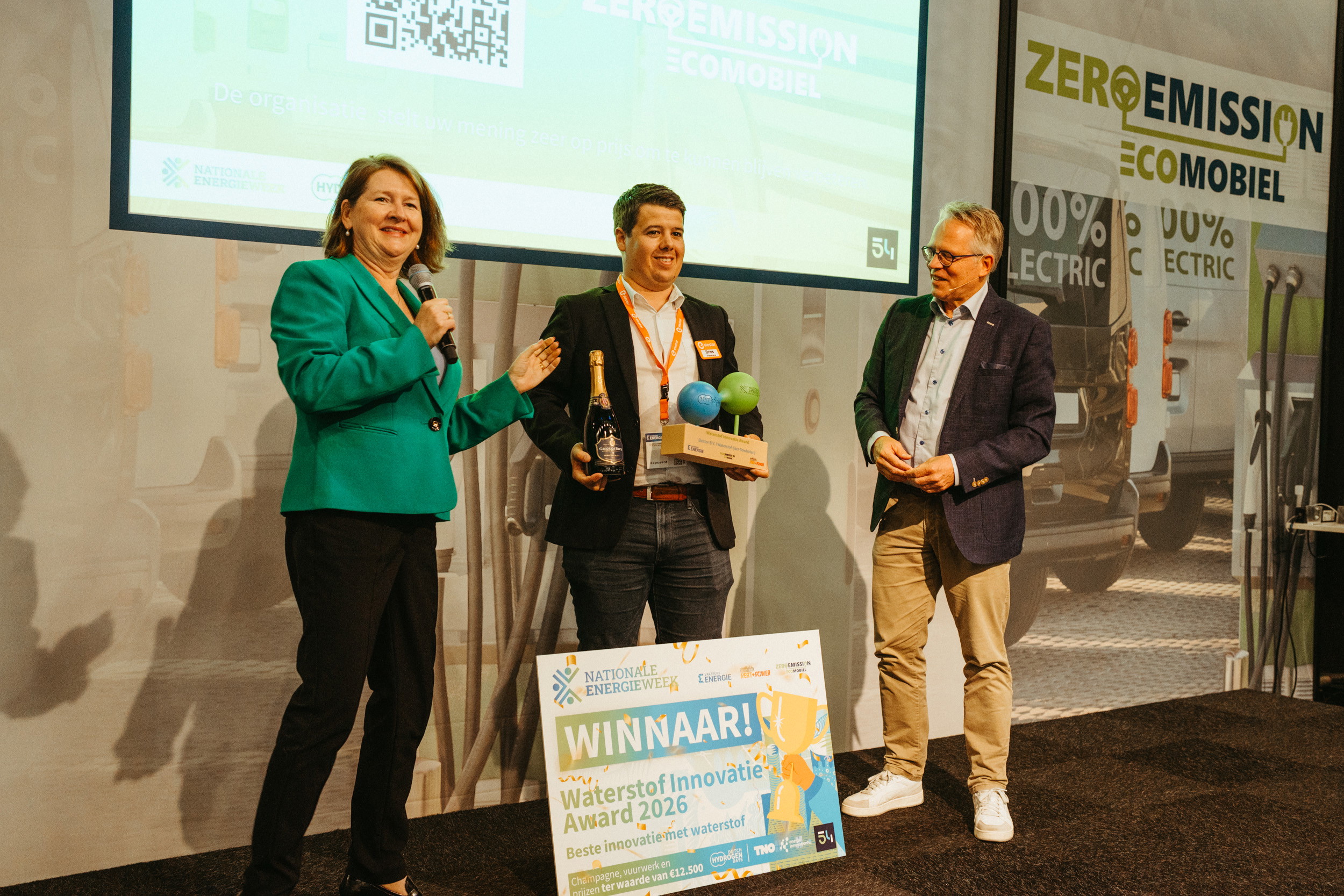
Elestor wins Hydrogen Innovation Award 2026
We are proud to share that Elestor has won the Hydrogen Innovation Award 2026 for our hydrogen–iron flow battery technology.
Read more
Elestor nominated for the Waterstof Innovatie Award 2026
We are pleased to announce that Elestor has been nominated for the Waterstof Innovatie Award 2026 with our hydrogen–iron flow battery technology.
Read more
Interview with EE Aktuell
In an interview with Erneuerbare Energien Aktuell, our CEO Hylke van Bennekom explains how Elestor’s hydrogen-iron flow battery is designed for long-duration energy storage, and why that becomes increasingly important as renewable energy grows.
Read more